 OttoGets the suppliers bidding, then stands back

- Built for
- Hotels and restaurants buying food at volume
- How it works
- Subscription, sign up per property
- Stage
- Live
The problem
Food buying runs on the same handful of suppliers, the same prices and a purchasing manager with neither the hours nor the leverage to challenge any of it. Quotes arrive by email in different formats, comparing them line by line is manual, and nobody finds out what a competitor would have charged for the same case of tomatoes.
What it does
Procure-360 turns the weekly food order into an auction. You post the list, vetted suppliers bid against each other in a live round with a countdown, and you award each line to whichever offer suits, not always the cheapest. Suppliers can see they are being compared but not against whom, so the price moves without anyone having to negotiate a call.
What it has actually done
Thirteen weeks of auctions at a live hospitality group, 1,386 competitive awards, measured against the price list they were actually buying on in April 2026, before any of it went to auction. Only a fifth of their catalogue has been through the platform so far.
- 7.4%
- Off the prices they were already paying490 lines, April 2026 purchase price against the latest winning bid, same pack size on both sides
- 10.0%
- Where a line has been auctioned more than onceThe 295 lines that ran in two or more weeks. The price ratchets down each cycle
- €148,000
- A year back on €2m of spend put through itIllustrative: the measured 7.4% applied to €2m of auctioned spend
- 96%
- Of auctioned lines now cost less than before470 of 490. Twenty went up, and they are visible too
- 85%
- Less driving between suppliersReported by the buying team, not measured by the platform
- 72%
- Fewer calls and emails per cycleReported by the buying team, not measured by the platform
Every price figure is a like-for-like comparison: same product code, same stated pack size, the price their incumbent supplier charged in April against the price an auction settled at since. Savings vary by category. Sauces and oils fell 23% and tinned vegetables 12%, while dry goods and seafood barely moved. We will tell you which of your categories are worth auctioning before you commit to anything.
How it works
Live auctions with a countdown
Each cycle runs as a real auction rather than an inbox of quotes. Suppliers price against a clock, and you watch the line move in real time.
Masked competitive data
Suppliers know they're in a competitive round but not who else is in it or what they've bid. That's what keeps the pricing honest without starting a race to the bottom.
Vetted suppliers, checked before they bid
A supplier registers with a company legal name, a VAT number and a registered address, and somebody reviews all of it before they are allowed near your list. Those details are locked afterwards, so the company bidding in week twelve is the one you approved in week one.
Request to award in one weekly cycle
Post the list, collect the bids, award the lines. One predictable rhythm instead of a rolling negotiation that never quite closes.
Two ways to deal on the same list
Commodity lines go to auction. Anything better settled quietly, the wine, the eggs, a seasonal contract, is marked negotiable instead, and suppliers send a price and a quantity you review off the clock. One list, both mechanics, no second process to run.
Every price on the record
Each bid is timestamped and attributed, and each award shows exactly what it beat. Buying stops being one person's judgement in a corridor and becomes a record your finance team can audit line by line. Nobody has to be suspicious of anybody, because there is nothing left to take on trust.
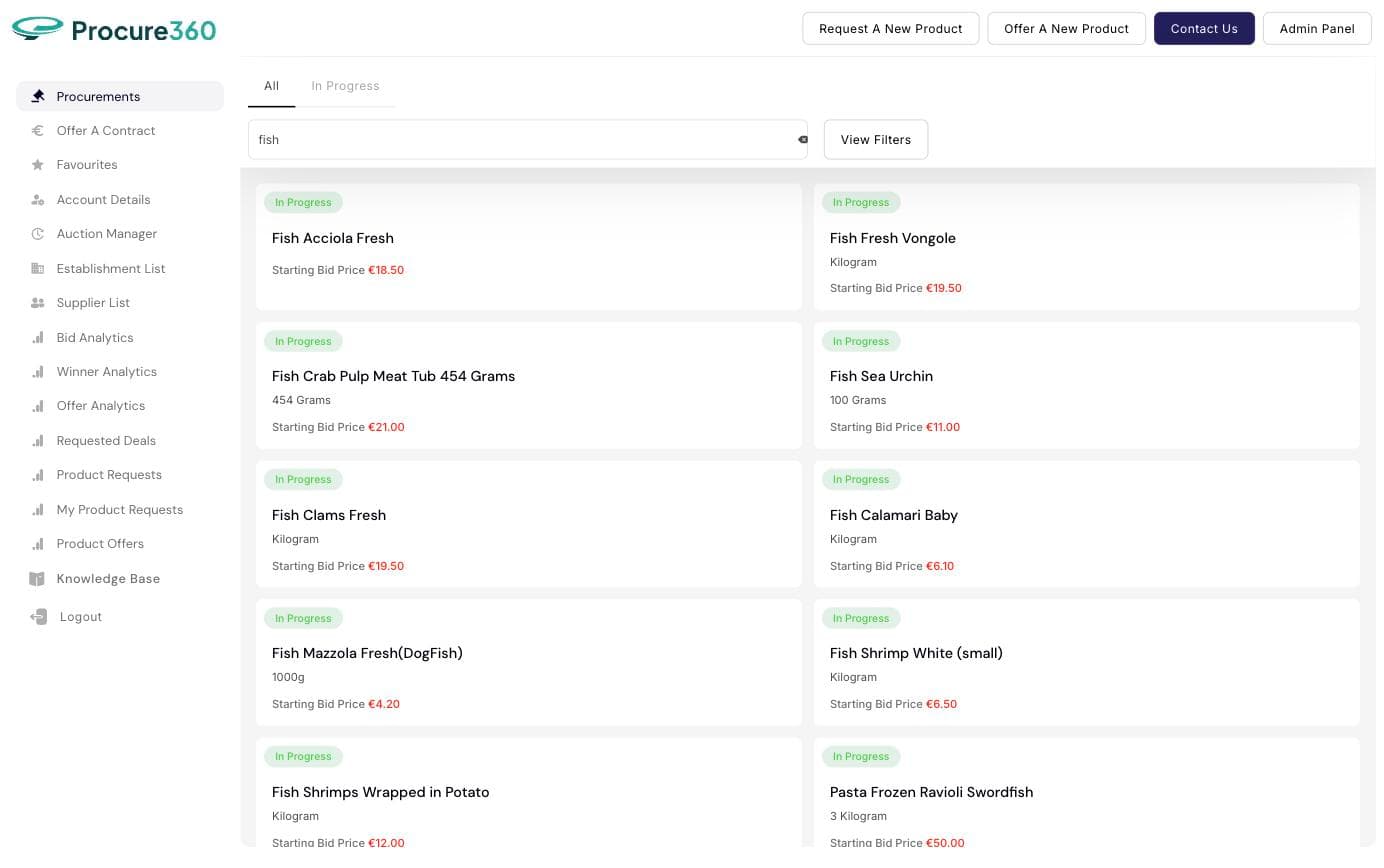
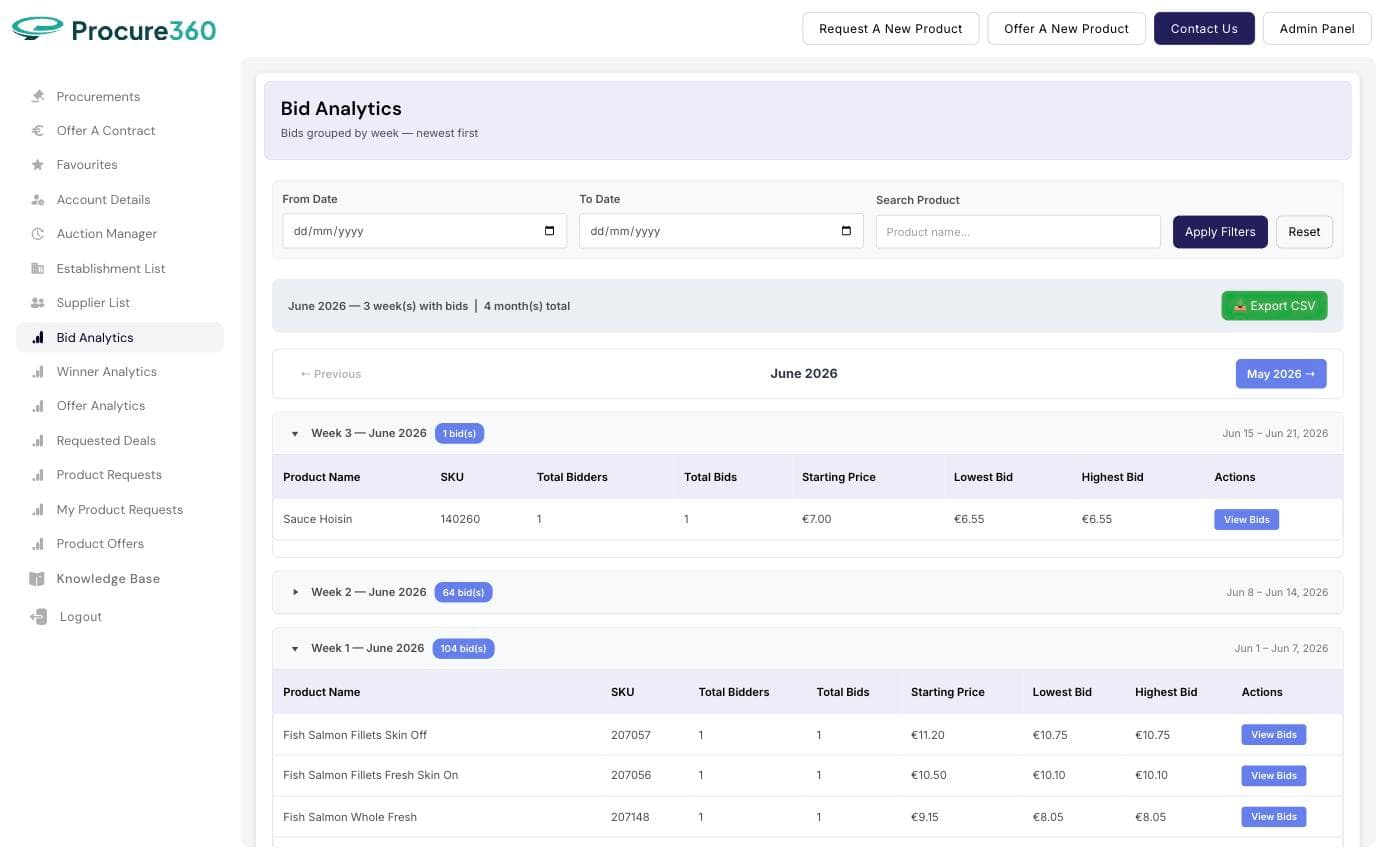
A look at it
Screens from the running platform, taken on the demo instance so no client's suppliers or prices are on show.
Where it's up to
Kept current on purpose. If it isn't in the left column, it doesn't work yet.
Working today
- Live auctions and countdowns on a weekly cycle
- Masked competitive data between bidding suppliers
- Six ways to deal, and offers with a clear expiry
- Bid and winner analytics
- Dashboards for every role
Next up
Roadmap to be published.
What it costs
Priced against what it saves you, not against what it cost to build. Every tier is covered by a fraction of the measured 7.4%, and the suppliers bidding on your list never pay a cent.
Single site
€950per month
One restaurant or hotel buying on its own account.
- One establishment, up to 1,000 product lines
- Weekly auction cycle on schedules you set
- Bid and winner analytics, with CSV export
- Supplier onboarding and compliance checks
Covered by €154,000 of spend put through it
Group
Most take this€1,950per month
A group running several properties off one buying team.
- Up to 5 establishments, up to 8,000 product lines
- Everything in Single site
- Offer a Contract for lines better settled privately
- Reporting per property and across the group
- Extra properties at €150 to €350 a month each
Covered by €316,000 of spend put through it
Enterprise
From
€3,500per month
Multi-site operators with their own finance and IT rules.
- Unlimited establishments and product lines
- Single sign-on and custom approval workflows
- API access and scheduled exports to your finance system
- A named account manager
Covered by €568,000 of spend put through it
Getting started
Onboarding is €8,000 to €15,000 once, and it is real work: your catalogue imported against your own SKUs, your existing suppliers approached, vetted and trained, your bidding and award schedule configured, and your buying team shown how to run a week.
Suppliers are never charged. Charging the side that does the bidding is how a marketplace dies, and the bidding is the whole product. Annual prepay is ten months for twelve. Payback figures apply the measured 7.4% to the spend you actually auction, so the honest first question is how much of your list is worth putting through it. We work that out with you before you sign anything.
Built with
- Next.js
- TypeScript
- PostgreSQL
Interested in Procure-360?
We're taking on a small number of early properties. Ask us anything, including what it can't do yet.
Talk to us about Procure-360